Sunday, January 20, 2013

Other species, extinction, and extraterrestrials

One of the things that has been leveled against the religious of any and all faiths is the human-centric viewpoint many of them have. And furthermore, the geocentric viewpoint. That's part of the reason I wrestle with the topic of interplanetary paganism, but it raises some other interesting thought experiments.
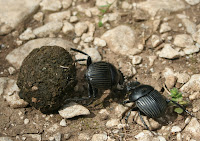
Life lesson?  It happens.  Work with it.
One of the big ones I always wonder about is reincarnation. Not all pagans, and not even all Wiccans believe in reincarnation. I happen to be one who does. There are a lot of questions, theological and otherwise, with reincarnation. Whole books can be and have been written on the topic. But one of the common conceptual debates for those who believe is that of inter-species reincarnation. On a conceptual level I can see no reason why we couldn't be reincarnated as an animal. Our paths in life are often guided by the lessons we are to learn at a given time (I wrestle with the question of 'toward what end?' and whether that's important) and I think life as an animal could be a valuable one. And who among us pagans, or even among animal lovers, has felt the intelligence and empathy in the eyes of a pet or even a wild animal?

But what about extraterrestrial life? Could we reincarnate entirely outside of our planet? Just something to think about. I, personally, say yes to that question. Before you go thinking I'm just a sci-fi geek (and I am), I do so because I believe that with the evidence we have from the numerous planet finding missions like Kepler, there's sound reason to believe life exists elsewhere. Every other natural phenomena we find is found in more than one example in the universe, I think it's almost silly to presume that everything happens regularly in the universe but life just so happens to be the only thing that happened once.

And what of the Fairy folk, of demi-gods, etc? Who's to say they aren't viable incarnations? I'm not the first one to raise that possibility. Not by several millenia.
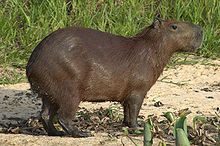
That face is as wise as any owl I've seen.
Stepping away from reincarnation, let's take it from the approach of totem animals, animal guardians, etc. Often we hear of pagans finding totem animals, spirit guardians and the like typically from the stock of woodland, land-dwelling creatures. I'm not saying we pick those spirits, it's a collaborative process, to be sure and often we are the ones being chosen. But what of the other species who never appear on that list? Couldn't a wombat or a capybara serve the same role? Or, sticking closer to home, are oppossums and garter snakes simply uninterested in the role? Or are they and are we simply not paying close enough attention? Perhaps we should open our ears, eyes and spirits to guidance from the creatures last-picked on the guardian animal team, so to speak.
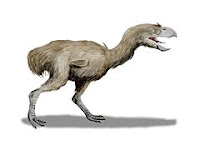
Pay some respects to grandmother Paraphysornis
For that matter, what of our ancestors? I attended a festival at which we thanked a grandmother tree whose roots remained, but whose trunk and branches had been removed years ago. And you could feel her presence in that space. Could we not speak to and thank the spirits of animals for which there is no living representative? Granted we don't want to open our ears too far. Life has been around for arguably billions of years. That's a lot of noise. But one of my prized finds which has featured on my altar from time to time is a fossil worm I found in Arkansas. As a Geology geek, this worm was an incredible find. Rarely do soft-bodied critters show up so nicely. But as a pagan, fossils have always spoken to me loud and clear "we are as important to this planet and its history as the wolf or the raven!"  And so it takes a place of honor on account of its age and the fact that it has survived to tell its tale to me where millions like it went without a trace.  There's a host of incredible animals that have walked this planet, some of them are actually our ancestors. Do they have anything to say to us? Would we know their voices if they did?
Hey, it's cousin Plesiadapis.  You never call, you never write.  I'm your cousin for Pete's sake!
So I've been thinking about what I'm writing in these blog posts. Are they sometimes silly? Yeah, that's how I write. And I'm all over the place, asking questions I could go a whole pagan lifetime without asking and I'd be just fime. But for all that, I take these questions seriously. It's important to me that my faith make sense both spiritually and logically. And exploring my faith is as much to me a thought experiment as it is an experience dancing around a Beltaine fire or calling my corners. For whatever the gods have meant for me to learn in this life, they've made a pretty strong point that what I'm good at is taking the bigger view, cracking jokes, and obsessing over details.

Friday, January 4, 2013

Relations with the Gods

Here's one that has turned over in my brain more the past year or two than any other.  How do we relate to Gods and Goddesses from different pantheons?  That's a pretty wide question, so let's narrow the scope a little, here.  Let's presume a hard polytheistic approach to deity, as anecdotal observation by various respected pagans suggests is more an more the case as modern Paganism continues to develop.  I'm also approaching from that angle as it's more and more my take on deity.  And let's stick to a ecclectic Wiccan approach to ritual, though by no means do I feel the need to.

Papa Legba's Veve
Now, I know how I've decided to relate to my deities, and while I wrestle with details, I think I've come across a reasonable approach.  That being I recognize other deities and give them their due honor, but after much struggle, I find it difficult to adopt them within my regular practice.  For instance, I was recently drawn to Papa Legba, of the Vodun traditions.  He and I have some history outside of actual practice and belief, and we share a lot of commonalities such as language and travel.  But Papa Legba has a very particular way in which he likes to be approached and, as with many Loa of the Afro-Carribean traditions, he does not get drawn down.  He rides you.  You might take a Religio-Wiccana approach to it and say that the spirits riding you is very much akin to drawing down a deity.  And in some respects, you'd be right.  But that is not the view of Vodouisants, at least so far as I understand it.  And so, while I pay my respects to Papa Legba, I have chosen not to incorporate him directly into formal ritual.  I'm not saying other pagans need to approach it this way, it's just how I have.  Indeed, it's critically important given the format of modern paganism that each practitioner arrives at their understanding organically.

So how have pagan groups approached others worshipping their deities?  Neo-pagans I think have it right on the head in that from what I read of it, it was an orthopraxy, not an orthodoxy, at least with respect to European traditions.  It was more important to conduct the ritual appropriately to the deities with whom you associated than to which deities you conducted your rituals.  That, however, greatly oversimplifies it.

In Greece, for instance, Zeus was the head of the Gods and the others fell in rank below him in some fashion or another.  He wasn't omnipotent, infallable, or even exclusive, but he was the top of the heap and while other Deities were recognized, Zeus and his family of Gods and spirits were always the heart of Greek worship and practice.  And what's more, there was a way in which you paid your respects to the Greek Gods, often in the form of sacrifice.  And that way was not the way they are addressed through some modern rituals, particularly outside of the reconstructionist mold.  I feel adopting them whole-cloth as deities within my own circle is somewhat like vigorously shaking the hand of a previously uncontacted tribesman.  He'll have absolutely no idea what I'm getting at by that gesture, and may or may not get a warm fuzzy feeling from me doing so.

The ancient Romans, on the other hand, engaged in what is often referred to as Religio Romana, that is, they tried to find analogues between their own Deities and the Deities of other cultures.  And in many cases there is evidence that those other cultures obliged when they fell within the Roman sphere.  Again, the Romans had their pantheon of Deities.  And while they were far more willing to adopt other deities as officially recognized cults within the empire, you still paid your respects in a very particular way to the state Deities, while privately addressing the deities and spirits of your family, home, and city in their own unique ways.  This, perhaps, is closer to the modern Neo-Pagan approach.

But again, it wasn't the whom, it was the how.  You were free to conduct ritual or prayer to Apollo, indeed you'd be expected to in Rome, even as an outsider.  But you'd be expected to do so appropriately.  And again, the four elements, drawing-down, divine couple approach of Wiccan-inspired paganism is not necessarily in keeping with that.  So am I not allowed to pay respects to Artemis?  Certainly that isn't the case.  But I get a little uneasy addressing her using ritual as I've learned it.

Pan
And here's where it gets interesting to me.  The Romans took their Religio Romana tack with respect to the Greek pantheon.  I think anyone who has had even the slightest education in the classical Greco-Roman world is familiar with the striking similarities between the Greek and Roman Deities.  In large part that's because the Romans did their best to fit the Greek Gods into their world view.  Did they view them as 'aspects' of the Roman Gods?  I think that depends on the Roman in question and the time period.  And I think some argument could be made for both having in some sense been true.  This, of course, gets more complicated as you get further into the commonalities in Indo-European, Afro-Carribean, etc deities.  But that's a topic for another post.

In all of this I've found myself walking away from the idea of aspects.  Indeed I think I've always felt a little uncomfortable with calling the Goddess of Wicca by Astarte or Diana or the God by the name Pan.  To me they are not forms of the triple Goddess or Horned One written about in so many books despite their similarities, but are entirely their own character.  However, in my view they are, perhaps, related.  This view is developing as I go along and as I find myself drawing closer to the divine.

From what I've seen, I'd agree with the hypothesis that modern pagans are drifting more toward polytheism. And I think we are headed quickly for a Roman-style model of recognition of deities, though I don't think state deities are part of that picture.  It is, in essence, almost a Unitarian Universalist approach, but distinctly pagan flavored.

Monday, December 3, 2012

Death and rebirth at the bottom of the ocean

I'm starting to write some of the short geology stories, and I'm finding it difficult, but enriching. The writer in me wants to draw all sorts of analogies, but the universe and the planet operate on such grand time scales that their beauty is hard to express in terms of our short seasons and lives.

As pagans, we see the seasons of the year as they come and go. The phases of the moon as it passes. The signs of the zodiac, for those that follow it. The children of the Earth see these cycles, and need these cycles. But for the Earth herself, they are like seconds on a clock, passing very quickly. To her there are greater, deeper cycles. And we can see those cycles if we pay enough attention.

Deposition cycles are some of the clearest examples. They read like tree rings, telling stories of periods from years to millenia to eons. And when you know what you are looking at, it is absolutely awe-inspiring to see it.

Some of the biggest, most beautiful structures, that fit the cyclical view the best, are turbidites. In the deep oceans on the continental shelf, there is a constant flow of gravel, sand, and silt laid down from rivers like the Mississippi or the Nile. They slowly pile up in a rather haphazard sort of way until, like an overbirdened snow pack, they give way and rush down the slope in huge avalanches of sediment, burying everything in their path. These sheets are tens, hundreds, even thousands of miles across and travel miles down slope.

What makes them so beautiful, and so breathtaking is how the sediment settles out. Just like in your middle school science class, the debris sorts itself by size, first depositing gravel, then sand, then silt, then clay. The richest, finest layers settling out on top With layer upon layer piling up like this, you can see nice, clean lines indicating each cycle. And in the clay layers you can often find tracks and even remains of plants and animals that, in a grand cycle of death and rebirth, thrived on the rich, marine beds before themselves being buried in preparation for the next cycle.

And just like the animals of the temperate climates above the waves need the cycles of cold to lay down what is to become new, rich soil for spring, here life needs the renewal of rich mud upon which to build the next generation.

And so the wheel turns. As above (the waves), so below.

Saturday, November 24, 2012

Interplanetary Pagans

So here's one from way back in my days as a baby pagan in the 90's. I've asked this one before, and eventually I arrived upon the fact that I was over thinking a bit and just slow down. But the question is still unanswered, and perhaps is one of those questions that has more than one answer.

Much of the pagan world focuses on cycles of nature and peculiarities of the local environment. When I lived near the ocean, my practice keyed into that. In a few short years my family had developed a handful of traditions and rituals that would make no sense without the ocean and tides.

But what about space? My one case of personal celebrity mania is on Elon Musk, a man who speaks with certainty about travelling to Mars and starting a colony there. But what would paganism be there? There are seasons. There is weather. Some of it would be hard to work with, but it's there. But what of the four elements? Fire is pretty hard to come by on Mars. Water as well. Wind and earth are no problem at all. Can the four element model adapt to that reality? I suspect so, but what would it look like?

And how about the Moon? This was my original hangup. There's a little bit of water there. And an inch or two of atmosphere that is so completely unlike our own, even scientists hesitate to call it an atmosphere. And that's not even dealing with the fact that the lunar cycle is effectively meaningless on the face of the Moon. On the other hand, you are standing on the very face of the Lady. How's that for a personal connection with deity?

And there are complications with even wider patterns in space flight. For those who follow astrology, the rising and setting of the Sun in the houses are tricky. The planets have a whole new characteristic of motion that basically throws the whole chart out the window. I'm not an astrologer. Perhaps that issue is more solvable than I imagine, but it takes a little thought to work it out.

And how about casting runes or using a pendulum from orbit? Or pouring libations when the libation in question neither falls nor has any desire to stay in the libation dish, to say nothing of the irritation of one's fellow space fliers by the crumbs and stain-inducing liquid from cakes and wine.

Perhaps I am over thinking this. I know I am. But it's not without precedent. A few years ago some devout Muslims flew in space. They had to get official word from an imam as to when they needed to pray and how they work out where Mecca is from orbit. Paganism will adapt to space just as it adapts to areas with a rainy and dry season versus the temperate four. But what will Martian paganism look like?

The deeper story of stones

Since I was very young, I took an interest in nature. Not just nature, but rocks. Like the dinosaur geeks so many boys my age were, but I ended up taking some coursework in it and it has played a role, as one might expect, in my pagan faith.

And one important thing I learned from that point of view is that the story of rocks are as important as the correspondences they represent. In my view, perhaps more so. I'm not pretending I'm the first one to come up with this. But it is a point of view I hold quite deeply.

As a geology student, I was taught how to read the rocks. How to look at individual crystals, their shapes, sizes, and orientations. How to look at the angles the ancient beach sands are sloped at and the criss-crossing bands of quartz running through them. How to look at whole mountain ranges and tell the story of the skin of our Earth. It dawns on me that while geologists eventually break out their mass spectrometers, chemicals, and polarizing microscopes, the end result is always a story. And stories are what paganism is all about.

These stories are ancient and modern, dynamic and catastrophic, and yet quiet, still and slow. You can go to Hawaii and find crystals that are minutes old. In the deserts of Western Australia, you can find crystals that are nearly as old as the Earth itself. And I am blessed with the background to look at one rock face, today, and tell a story billions of years old. (Please don't read this as me being a professional Geologist, I am at best a skilled amateur.)

I tried to write all of this down once. But I think the better angle is to write a series of short stories about these deep cycles. I'm terrible about commitment, at least with respect to personal habits. So I'm not going to promise a weekly feature, but I'll try to write something semi-regularly.