So I haven't kept up to my initial motivation level with this blog, but I've made peace with that. I knew it was a likely outcome as the rubber met the road and so it has been. I think the central component was realizing what my boundaries were with respect to it. I'm not a science expert, nor do I have a team of experts at hand to help me research topics and I don't get paid for it, so I have to hold up a job, which means less time to research and write a blog. So I'm sticking to what I know, researching where I can, and not apologizing for things I haven't the time or knowledge for at present. But enough meta mumbling.
I've found over the past few years that when you get right down to it, one of the few common threads in much of modern Neo-Paganism (as contrasted with Reconstructionists) is the idea of the Wheel of the Year and the sacred meanings behind its turning. Many groups, Wiccan and non, observe this cycle in some form or another, and recognize its echoes in other areas of life from the four directions to the Rule of the Magi, to the signs of the zodiac and so on. This has perhaps become the most important piece of my personal faith in that, while I wrestle, rail, and debate the details of it all, the one thing that has stuck with me from day 1 and remained unchanged is the turning of the Wheel. It's perhaps the one constant underlying it all. And so, as noted in an earlier post, I have been focusing on how other cycles present themselves. In particular cycles that lie outside of the scope of the usual.
 |
See this pretty olivine basalt from Hawaii?
It's like rock reincarnation. And you
thought it was just shiny. |
So, as this has been trending toward becoming a bit of a geology/space blog (they are central pieces of my geekiness, after all) I've been looking at plate tectonics. We're the only planet we've ever seen that has it, and like the Sun renews it's dominance in the sky and the Moon refreshes her face as the month rolls on, the Earth's surface refreshes itself via tectonism. Taking the broadest approach, tectonism is a story of making new from the old. One plate is subducted below another where it sinks, melts, then rises to the surface as a volcano. Continental plates subduct below other continental plates and form the grandest mountains on our planet. And voila! Everything old is new again. My minerology professor in college had a leading theory, in fact, that hot spots, the forces that drive volcanism under Hawaii, Yellowstone, and the Galapagos, among others, is a function of extreme deep subduction of old oceanic plates deep into the mantle where, instead of the partial, bubbly melting plates do near the surface, they form huge plumes of melted rock. And if you look at the short list I mention above, they are characterized by new, fresh growth. New land from the volcanoes themselves, new life on the fertile soil that results. It's really what they're known for.
But it isn't perfect. As the plates subduct, pieces are scraped off on the continent overlaying them. Island chains get glued to the mainland. Recent evidence shows that pieces that get subducted break off and stick to the underside of the continents and continents drifting across the oceanic plates, like India did, leave bits of themselves behind where they sink into the seafloor making undersea mountains that, until recently, we had no good explanation for. But when you think about it, that's not so different from the Wheel of the Year we all know. Sure, every year the seasons reset themselves. But look at last year. The warm winter and hot summer led to a drought we are still dealing with now in North America. The seasons still turn in Egypt, but the desert eats just a little bit more of the green every year. Hurricanes batter shorelines and swallow whole islands and build new ones elsewhere. Just like returning in the next life. We're mostly new, but bits and pieces hang on.
 |
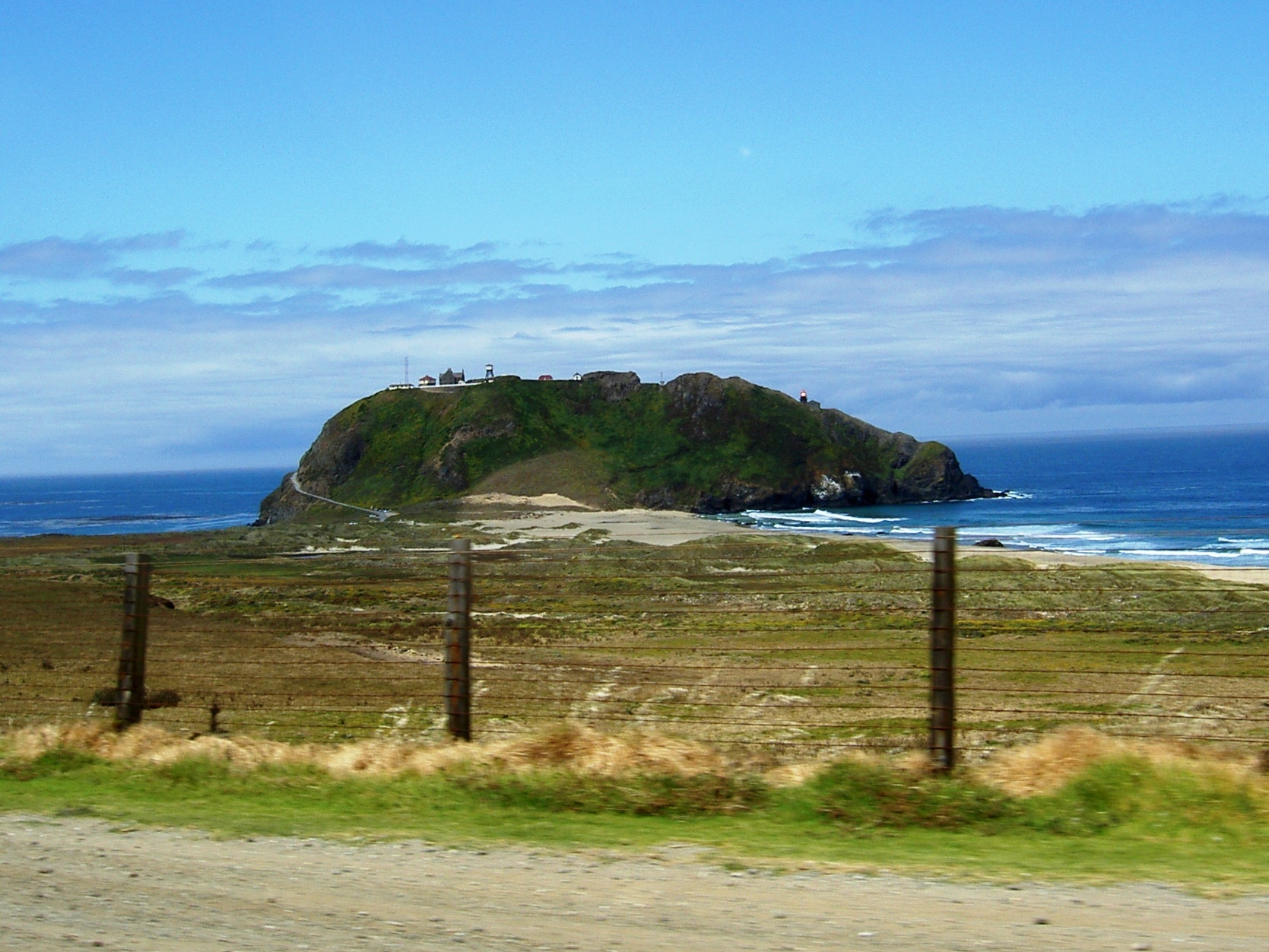
See that island? That's another continent. The same one
that made Mount Saint Helen's blow up. Whispers from a
past turn of the tectonic wheel.
(Point Sur Lighthouse in California) |
It reminds me of the classic boat thought experiment. If you replace the boards in a boat one by one, at what point is it a new boat? Or is it still always the old one? Or is it both? Are the slabs of the Farralon plate stuck to Washington, California, Central America and Canada the Farralon plate or the North American plate? Is the hurricane blowing this year due to conditions set in motion one, two, even five years ago still entirely this year's hurricane? Or does it really belong to the warm ocean currents of 2010? Is the piece of me left over from my childhood or from a past life still that child or that past person? Or is it just me, right now? Or both? There is no right answer and what answer we give says a lot about how we think about the world.
That's the thing about a cycle. It's new, but it's the same old story. A spiral, as we like to say.